

It has never been easier to build software. Describe what you want to an AI model, watch it write the code, click a link, and there it is: a working app. Login screens, dashboards, forms, payments. Things that used to take a development team months now show up in a few hours.
We use AI every day in our own development work, and we are not here to tell you it is a fad. It is the biggest shift in how software gets built in our careers. But there is a real difference between letting an AI build something that works and building something that is secure, maintainable and ready for real users. That difference is the gap between vibe coding and AI-assisted development, and it is where most of the risk lives.
What is vibe coding?
Vibe coding is building software by prompting an AI model and accepting what it produces, judging success mainly by whether the app appears to work. You describe the outcome, the AI writes the code, you test it by clicking around, and you keep prompting until it looks right. There is usually no plan, no review of the code itself, no separation between testing and production, and no record of why anything was built the way it was.
For prototypes, internal experiments and proving out an idea, vibe coding is great. It is fast, cheap and a fantastic way to learn what you actually want. The trouble starts when the prototype quietly becomes the product, with real customers, real data and real money flowing through it.
What is AI-assisted development?
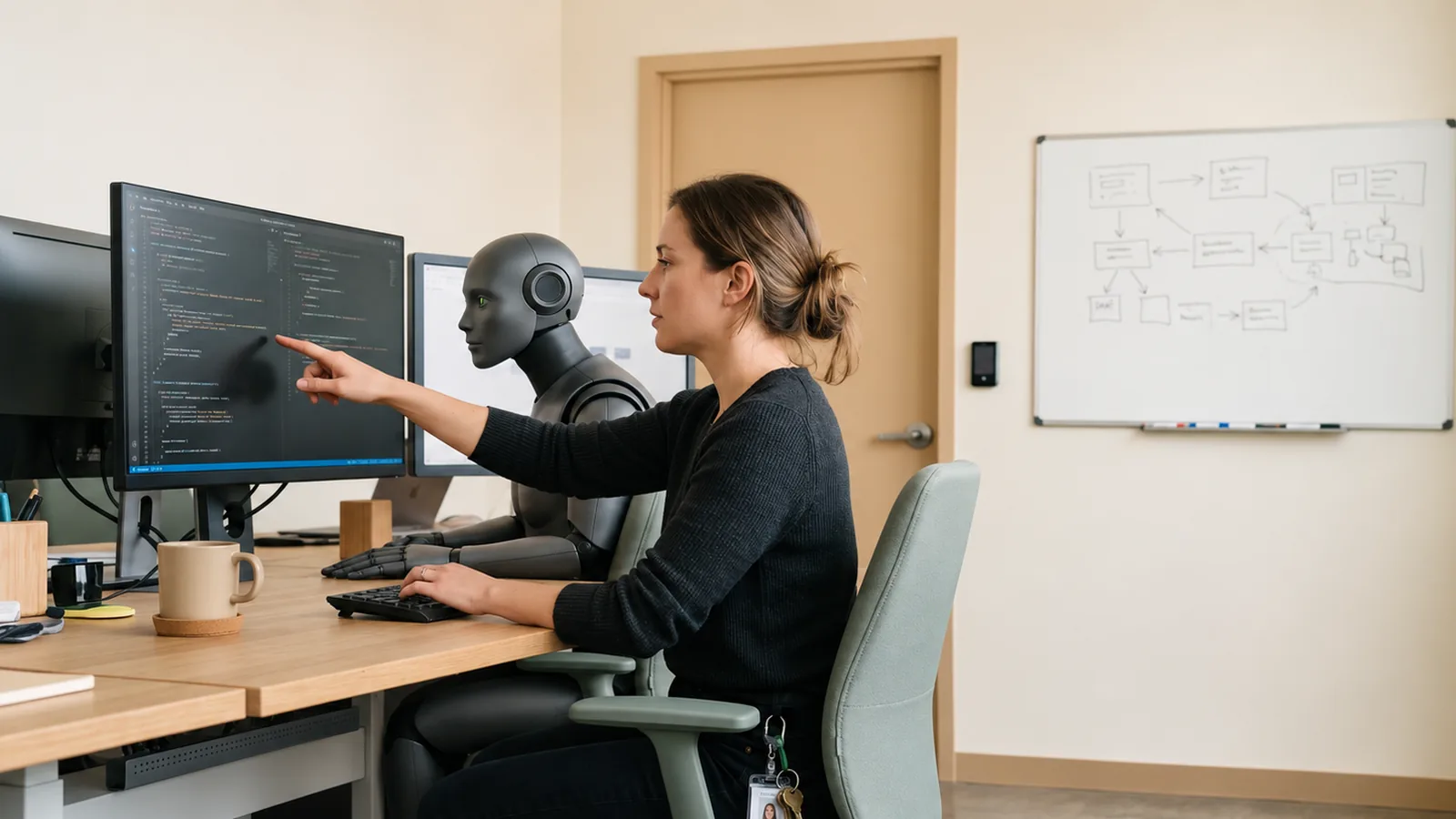
AI-assisted development uses the same AI models, but inside a professional engineering process. The AI accelerates the work. People own the decisions. Every change is planned, reviewed, tested in a separate environment, approved and only then released. The speed is still there, but it runs on rails.
Here is the simplest way to put it:
| Vibe coding | AI-assisted development | |
|---|---|---|
| Starting point | A prompt | Discovery and a written scope |
| Measure of success | It runs | It runs, it is secure, and someone else can maintain it |
| Who reviews the code | Usually no one | A person, before anything ships |
| Where changes happen | Often straight in the live app | Development, then staging, then production |
| Secrets and keys | Often pasted into the code | Kept out of the code, limited and rotated |
| If the AI tool disappears | You may be stuck | Any qualified developer can pick it up |
| If something breaks | Hope there is a backup | A tested rollback plan |
The numbers behind the risk
This is not a scare tactic. The research is consistent:
- Veracode, 2025 GenAI Code Security Report: across more than 100 AI models, 45% of coding tasks produced code with a known security flaw, the kind of vulnerability listed in the OWASP Top 10. Newer, larger models did not write meaningfully more secure code than older ones.
- Wiz Research, September 2025: in a study of apps built on popular vibe coding platforms, 1 in 5 organizations building on those platforms had exposed themselves to serious risk through common, high-impact misconfigurations.
The speed that makes vibe coding feel magical is the same speed that skips the steps that keep an app, and its users’ data, safe.
Where vibe-coded apps go wrong on security
Most of the problems we see are not exotic. They are basic mistakes that a reviewer would catch in minutes, and that an AI model will happily make if no one asks it not to.
- Exposed API keys and secrets. Keys for payment processors, email services or AI providers get written directly into code that ships to the browser, where anyone can read them. Automated bots scan public code and websites for exactly this, constantly.
- Login that only happens in the browser. The app hides a page behind a login screen, but the data behind it is still reachable by anyone who asks the server directly.
- Databases left open. Storage buckets and databases set to public during testing and never locked down again.
- No input checking. Forms and fields that accept anything, which opens the door to injection attacks and spam.
- Outdated or unknown packages. AI models pull in code libraries without checking whether they are current, maintained or even real.
- No logging or alerting. When something does go wrong, no one knows until a customer tells them.
None of these show up when you click around the app. It works. That is exactly why they are dangerous.
When AI goes rogue
Security holes are one risk. The other is an AI tool that takes an action no one asked for.
In July 2025, SaaStr founder Jason Lemkin documented a vibe coding session in which an AI agent deleted his production database during an explicit code freeze, after being told repeatedly not to make changes. That same month, a product manager testing Google’s Gemini CLI asked it to reorganize a folder and watched it misread a failed command, scatter his files, and then tell him it had failed him “completely and catastrophically.” Neither person was careless. They gave an AI broad access to live systems and trusted it to follow instructions.
The lesson is not that AI is malicious. It is that an AI model will sometimes misread a situation, act confidently on a wrong assumption, or ignore an instruction, and it will do it at machine speed. Instructions alone do not prevent that. Structure does.
Here are the principles we build around:
- The AI never holds the keys to production. It can propose changes. It cannot push them live on its own.
- Separate environments. Work happens in development, gets proven in staging, and only then is promoted to production. Live customer data is never the test bed.
- Least access by default. Every tool, person and integration gets only the access its job requires, nothing more.
- Back up before every change. Data and code are captured before anything is altered, so any step can be undone.
- A human approves every release. A named person signs off before anything reaches real users.
- Everything is recorded. Every change has a history: what changed, why, who approved it and how to reverse it.
Discovery: where real development begins
Vibe coding starts with a prompt. Professional development starts with questions.
Before anyone writes a line of production code, we need to understand how your business actually runs. That means sitting with the people who will use the software and mapping the work as it happens today, not as the org chart says it should.
- Who uses it, and what does each person need to see and do?
- What are the real workflows, step by step, including the exceptions and workarounds?
- Where does the data come from, where does it need to go, and who owns it?
- What systems does it need to talk to: accounting, CRM, email, payments, phones?
- What are the rules around privacy, compliance, consent and data retention in your industry?
- What happens when something fails, and who needs to know?
- What does success look like in six months, and what will you want next?
These answers shape everything that follows. Skip them, and you end up with an app that does what you asked for but not what you needed.
Scoping: deciding everything that is included
Discovery tells us what the business needs. Scoping turns that into a written plan for what will be built, what will not, and in what order. A good scope covers far more than the features you can see:
- Features and screens, phase by phase, so value ships early and the plan can adapt.
- Data model, meaning how information is structured, related and protected.
- Roles and permissions, meaning who can see and change what.
- Integrations with the tools you already use.
- Security requirements, including how secrets, logins and personal data are handled.
- Compliance needs, such as SMS consent, privacy policies and ad platform requirements.
- Hosting and ownership, meaning where it runs and who holds the accounts.
- Testing, backup and recovery plans.
- Documentation and handoff.
This is the part most people want to skip, because it does not feel like progress. In reality, it is where the biggest savings happen. A change made on paper during scoping costs almost nothing. The same change made after launch can mean rebuilding half the app.
So how long before actual development begins? Longer than a vibe coder would expect, and that is the point. On a serious build, a meaningful share of the calendar is spent understanding the work before code is written. The payoff is that once development starts, it moves fast, because the questions have already been answered.
Building it so someone else can take over
Here is a question few people ask until it is too late: what happens if the AI tool you used to build your app shuts down, changes its pricing, or simply gets worse?
If your app only exists inside one AI platform, written in a way only that tool understands, you are locked in. AI-assisted development avoids that by treating the AI as a fast pair of hands, not the owner of the work:
- The code lives in a repository you own, under your accounts.
- It is built on standard, widely used frameworks that any qualified developer knows.
- It is organized, commented and documented, so a person can read it.
- Hosting, domains and databases are in your name, not a vendor’s.
- Every change has a written history explaining what changed and why.
The test is simple. If every AI model disappeared tomorrow, could a competent developer open your codebase and keep going? With vibe coding, the honest answer is often no. With AI-assisted development, it should always be yes.
Risk assessments and deploy protocols
This is the part of professional development that vibe coding skips entirely, and it is the part that protects your business.
Risk assessment before every release
Before any change goes live, we write down what is changing, what it could affect, what could go wrong, how we will know, and exactly how we would undo it. That applies to small fixes, big features and even rollbacks. A rollback is a change too, and it can break things just as easily.
Review and approval
Changes are proposed, not pushed. Each one is packaged as a request to merge into the main codebase, reviewed by a person, and approved before it moves forward. Nothing reaches your customers because an AI decided it was ready.
Promoting through environments
Approved work is merged and deployed to a development environment first, then promoted to staging, where it runs against realistic conditions, and only then promoted to production. Each promotion is a deliberate decision, not an automatic one.
Verify, then keep watching
After a release, we confirm that what was supposed to change did, and that nothing else broke. Then monitoring and alerts take over, so problems surface before your customers notice them.
Is this slower than vibe coding? A little, at the moment of each release. Over the life of a product, it is dramatically faster, because you are not stopping to recover from outages, breaches or a database that disappeared overnight.
So should you vibe code?
Absolutely, for the right job. Use it to sketch an idea, test a workflow or show your team what you mean. It is one of the best prototyping tools ever made.
But when the app is going to hold customer data, take payments, run your operations or carry your brand, it needs more than vibes. It needs discovery, a real scope, secure engineering, human review and a release process that assumes things will occasionally go wrong, and plans for it.
AI did not remove the need for good development practice. It made it more important than ever, because now anyone can ship code faster than they can understand it.
Frequently asked questions
What is the difference between vibe coding and AI-assisted development?
Vibe coding means prompting an AI to build software and accepting the result if it appears to work. AI-assisted development uses the same AI tools inside a professional process: discovery, written scope, human code review, separate testing environments, risk assessments and approved releases.
Is vibe-coded software secure?
Often not by default. Veracode’s 2025 research found that 45% of AI coding tasks produced code with a known security flaw. Common issues include exposed API keys, login checks that only run in the browser and databases left open to the public.
Can a developer take over an app built with AI?
Yes, if it was built to be maintained: code in a repository you own, standard frameworks, documentation and a change history. Apps that only exist inside one AI platform can be hard or impossible to hand off.
How do you stop an AI coding tool from making unauthorized changes?
Do not give it direct access to production. Use separate development, staging and production environments, back up data before changes, require human review and approval for every release, and keep a full record of what changed.
What is a deploy protocol?
A deploy protocol is the set of steps every change follows before it reaches real users: a risk assessment, review, approval, testing in a staging environment, promotion to production and verification afterward, with a rollback plan ready at each step.
If you have a vibe-coded prototype that is starting to matter, or an idea you want built properly from day one, we can help you get from "it works" to "it’s ready." See how we approach web development, custom CRM builds and AI implementation, or start a conversation.
Sources
- Veracode, "2025 GenAI Code Security Report," July 2025
- Wiz Research, "Common Security Risks in Vibe-Coded Apps," September 18, 2025
- The Register, "Vibe coding service Replit deleted production database," July 21, 2025
- Ars Technica, "Two major AI coding tools wiped out user data after making cascading mistakes," July 24, 2025